Case Study / Foodtech · 2020–2022
Org Building
Building the design organisation behind Jubilant’s digital growth
TL;DR
Led Domino’s India’s first major UX overhaul in 15 years, rebuilding the ordering journey end to end: ₹20 Cr in incremental annual revenue and a 20.3% lift in new-user conversion.
Jubilant’s digital products were becoming an increasingly important part of how customers experienced its brands, but design was still a team of one.
I joined to build that capability. Over the following years, the design organisation grew from 1 to 15, while its role expanded from delivering interfaces to shaping customer experience across some of the company’s most important digital journeys.
₹20 Cr
Incremental annual revenue
20.3% ↑
New-user conversion
1 → 15
Design organisation
0 → 1
Popeyes digital launch
01 / Design Capability
1 → 15
Design organisation
Building the capability while transforming the product
The ambition for digital was growing faster than the design team supporting it. Building the function meant more than hiring designers. It meant defining the skills we needed, structuring the team around the product portfolio, agreeing ways of working with Product and Engineering, and setting one quality bar across brands and platforms.
The team grew from 1 to 15 once design had proved its business value, bringing together product, interaction and visual design. As it matured, Design entered conversations earlier, using research, data and experimentation to shape the problems being solved, not only the interfaces.
Component library


Research brief

02 / Domino’s
From ordering food to wanting food
Domino’s digital experience had become very good at helping someone complete an order. But efficiency alone wasn’t enough for a food brand. The experience also had to create appetite, make discovery easier and give customers a reason to explore.
Research, customer behaviour, competitive analysis and product data showed how people decided what to eat and where the app got in the way. From that, I pitched a shift in strategy: from a rational ordering utility to an emotional expression of the food and the brand.
Storyboard

Persona

Priya Patel · A composite persona that grounded the shift from rational to emotional ordering in customer research, not just a strategy slide
Nishant has a great sense of design and he was the go-to guy for any discussion on user experience. He contributed a lot towards revamping the Domino’s user experience end to end.
Ritesh Prakash · Product counterpart, Jubilant FoodWorks
03 / End-to-End Journey
The experience couldn’t stop at the homepage
A more engaging homepage meant little if customers still struggled at the moments that determined whether an order could actually be completed. The reframe from ordering to wanting had to hold everywhere a customer made a decision, not just the homepage.
Location and address, cart and payment were among the most consequential points in the journey, and where customer experience met restaurant operations most directly. We combined research, funnel behaviour, competitive analysis and operational constraints to rethink these journeys together, not as isolated screens.
Home
Making the experience feel like food
The homepage became a dynamic canvas for food discovery, using imagery, recommendations, contextual merchandising and interaction to bring the sensory character of Domino’s into an app that had behaved like a catalogue.
Underneath, we built the patterns and components that made it repeatable. One card, the Hero Card, went through many iterations before it balanced appetite appeal with decision speed.
Hero card
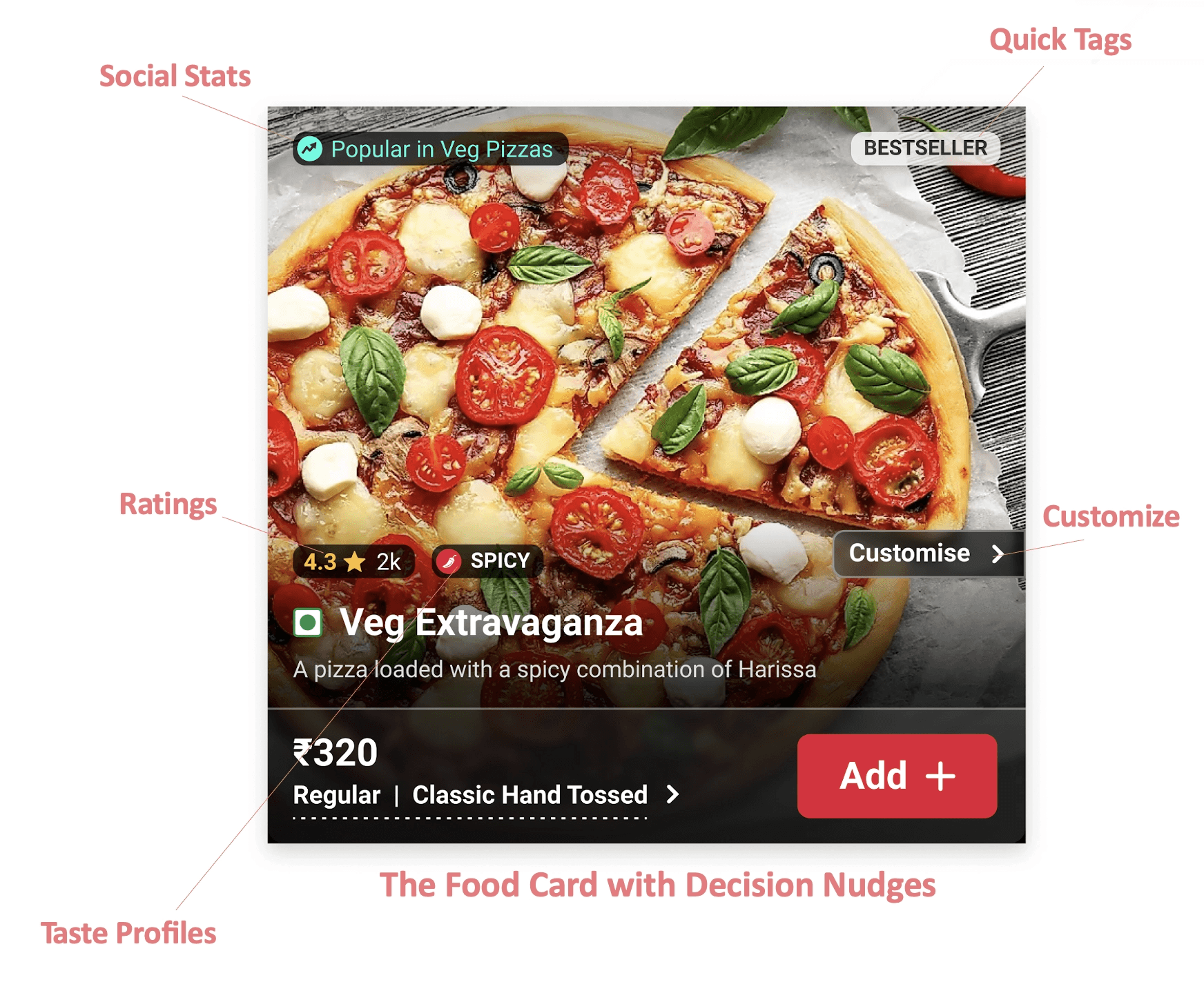
Ratings, taste profile and social proof help customers decide faster
Home, reimagined
A food-forward canvas built for discovery, not just ordering
Location & Address
Making deliverability easier to understand
Location was not simply an address-entry problem. It determined store availability, menu availability and whether Domino’s could fulfil the order at all. The experience was simplified around helping customers establish a serviceable location earlier and with greater confidence, while handling location and delivery constraints more clearly when things went wrong. The revamp lifted store-pickup conversion 46%.
Before

A dated, error-prone map
After

Area boundaries, points of interest and smarter zoom
Cart & Payment
Removing friction at the point of commitment
Cart and payment carried a different challenge: by this point the customer had already decided to order. Every unnecessary decision, unclear charge or failed recovery now risked losing an order that was already close to completion.
The team simplified the path to payment, clarified information and offers, and designed recovery for failure states. I also pushed for Magic Cart: pre-built carts customers could order in one click, designed to raise the value of each order.
Before
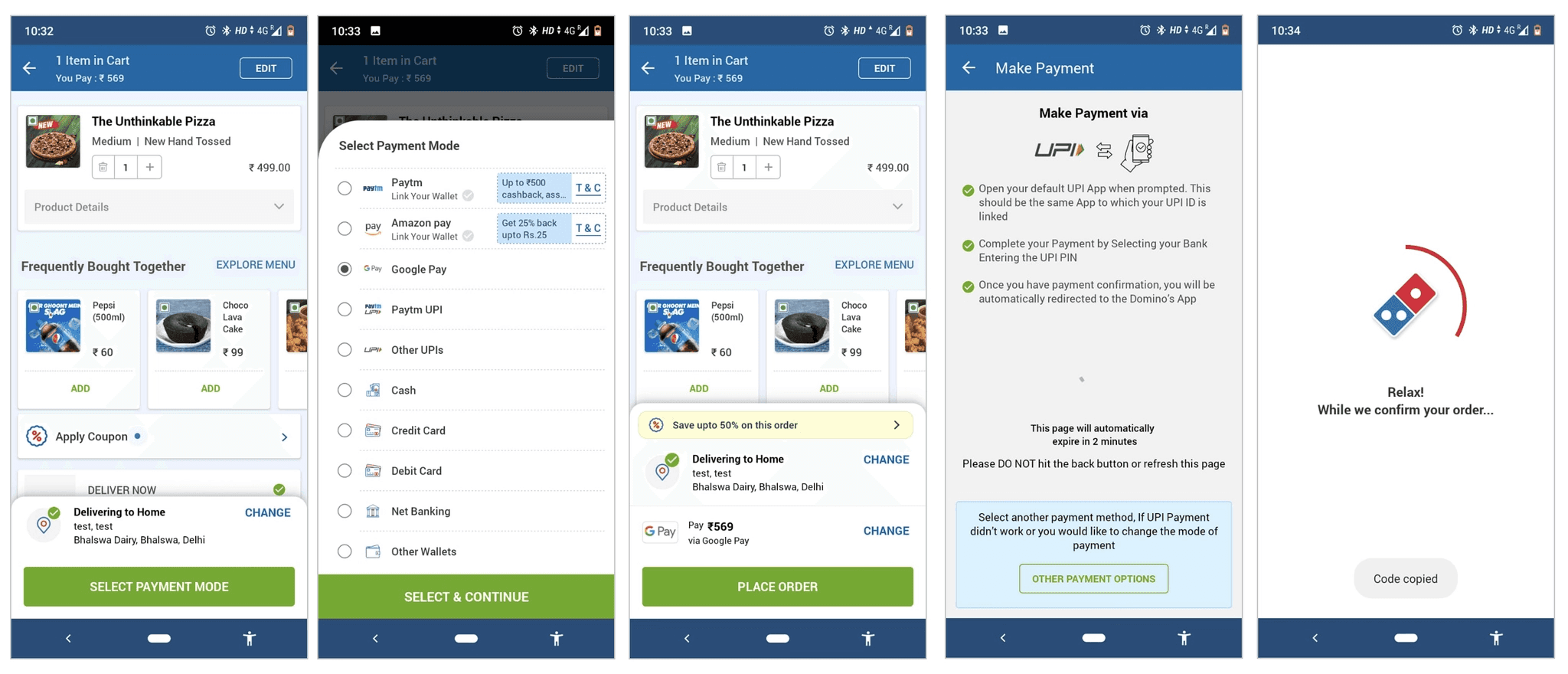
Checkout spread across redundant steps
After

Simplified checkout moves customers straight to payment
04 / CX × Operations
81% ↑
Conversion, non-deliverable
Better customer journeys created better operating outcomes
Location, cart and payment sat at the intersection of digital experience and physical fulfilment. Improving them therefore wasn’t only about reducing customer friction. Better decisions upstream could also reduce avoidable operational effort downstream.
One call here was mine. Instead of a dead end for customers outside the delivery area, I proposed incentives to switch to takeaway or a nearby store. Conversion for those customers rose 81%, from 0.54% to 0.98%.
Before

A dead end for customers outside the delivery area
After

No dead ends · Nudging non-deliverable customers to takeaway or a nearby store: 81% uplift in conversion (0.54% → 0.98%)
05 / Popeyes
0 → 1
Popeyes digital launch
Launching Popeyes online ordering from zero
Domino’s was about transforming an established digital business. Popeyes was different: bringing a global brand into India and building its online ordering from zero.
I designed the Popeyes experience myself, with one junior designer. The team was still small then; it grew to 15 later, once design had proved its business value. We translated the brand for Indian customers and built the foundations for discovery, ordering and launch.
Brand & design system
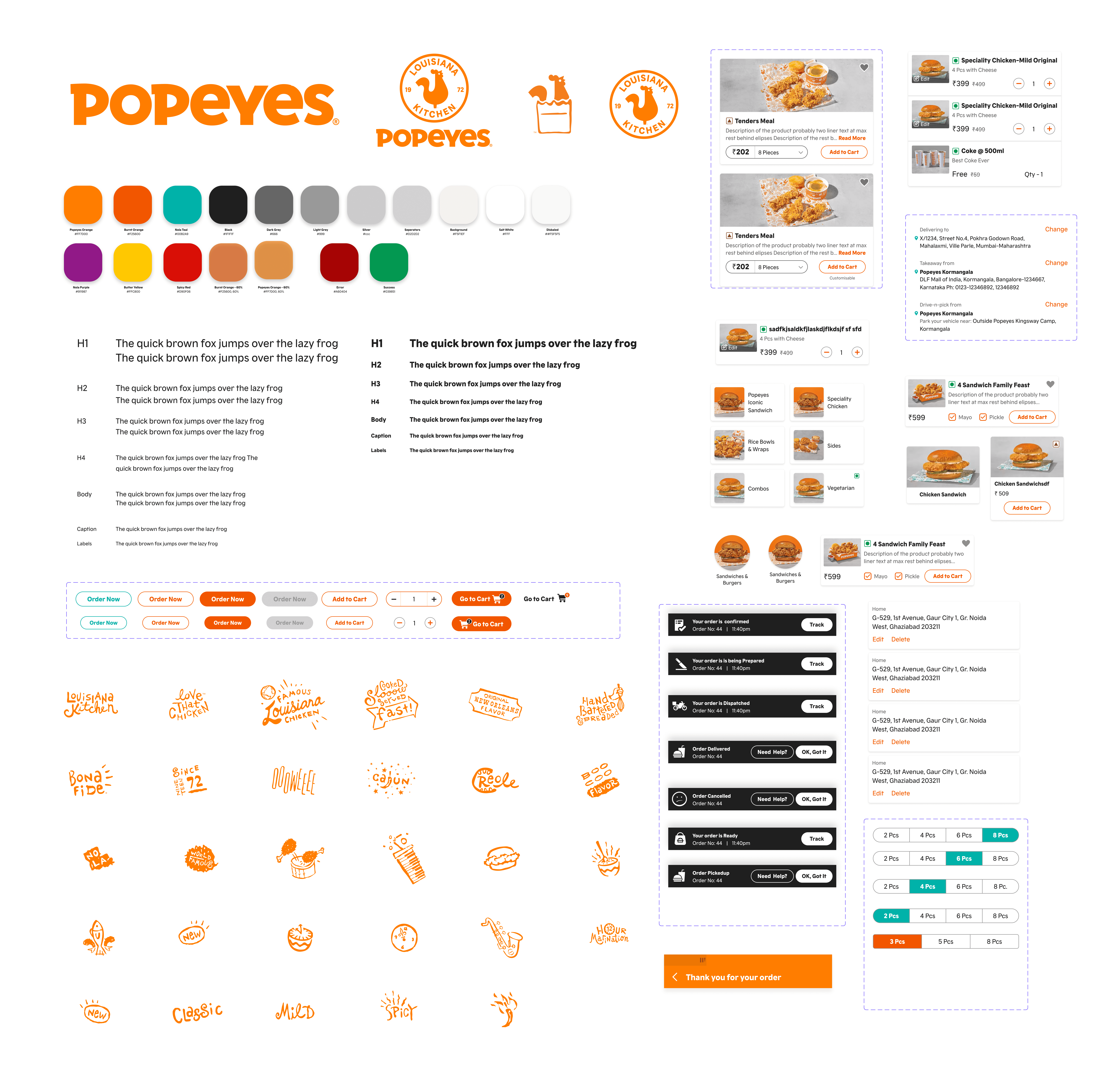
App

Popeyes India’s online ordering, designed from zero
Nishant and I worked together at Domino’s India, with the aim of making it a food-tech powerhouse. He headed a strong UX design team for the whole of Jubilant FoodWorks, across Domino’s, Popeyes, Ekdum and Hong’s Kitchen. He is one of the best product and experience design people I have ever worked with. His knack for understanding user personas and their pain points makes him a great asset to any organisation looking to build a solid product design team. He also delivers under pressure without compromising on quality.
Rahul Gupta · Jubilant FoodWorks
Outcome Summary
Design became part of how the business grew
What began as building a design team became a broader product capability. The organisation grew from 1 to 15, Domino’s moved from a largely transactional ordering app towards a more differentiated digital brand, and design decisions increasingly connected customer behaviour with commercial and operational outcomes. Domino’s India’s first major UX overhaul in 15 years delivered ₹20 Cr in incremental annual revenue, mostly through a higher average order value, and ₹1 Cr in annual cost savings.
Along the way, we also launched Popeyes online from zero.
₹20 Cr
Incremental annual revenue
20.3% ↑
New-user conversion
1 → 15
Design organisation
4.7 / 4.2
App Store / Play Store
Next Transformation